
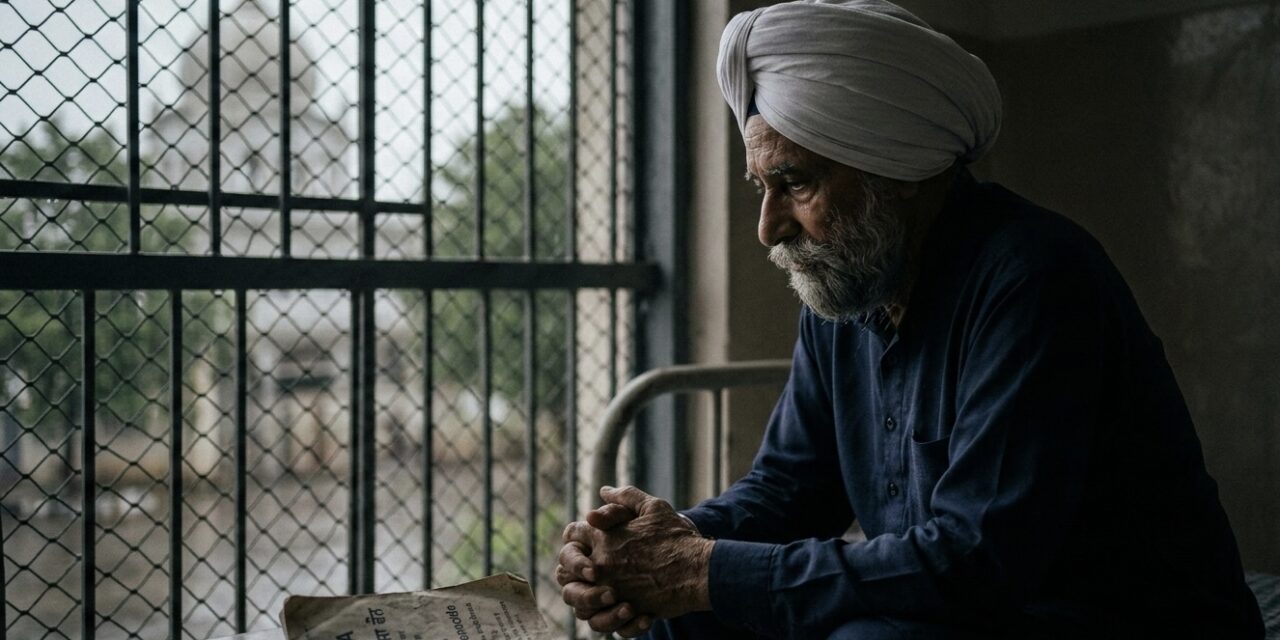
In the landscape of international human rights, there are cases that serve as a mirror to a nation’s soul. The ongoing incarceration of Professor Devinderpal Singh Bhullar, now entering its 31st year, is no longer just a legal matter; it is a profound question of whether “due process” has any meaning when applied to the marginalized.
On December 23, 2025, while much of the world prepared for the holidays, the Delhi Sentence Review Board (SRB) quietly met to decide the fate of dozens of lifers. On February 10, 2026, the verdict was made public: Bhullar’s application for premature release was rejected for the ninth time.
The Architecture of an “Infinite” Sentence
To understand the outcry, one must look at the foundation of Bhullar’s conviction. He was tried under the Terrorist and Disruptive Activities (Prevention) Act (TADA), a law so widely condemned for human rights violations that the Indian Parliament allowed it to lapse in 1995.
• A Verdict Divided: Bhullar’s 2001 conviction was based on a split 2–1 decision by the Supreme Court. The presiding judge, Justice M.B. Shah, voted for an absolute acquittal, citing a complete lack of corroborative evidence.
• The “Vegetative State”: After decades on death row, Bhullar’s mental health collapsed. In 2014, the Supreme Court commuted his death sentence to life imprisonment specifically because of his severe mental illness and the “inordinate delay” in deciding his mercy petition.
Despite these factors, the SRB continues to label him a “threat to national security,” even as he resides in a psychiatric ward at Guru Nanak Dev Hospital in Amritsar, physically and mentally incapable of posing a threat to anyone.
The Mirror of Selective Mercy
The February 2026 decision has reignited a fierce debate over ‘selective mercy.’ According to Jaspal Singh Manjhpur, the legal expert who has tracked the cases of the Bandi Singhs for years, the disparity is undeniable. He highlights a system where individuals charged with rape or communal massacres find a path to freedom, while political prisoners like Bhullar are held in a state of ‘judicial stasis’ that defies even the government’s own 2019 release directives.
Advocates argue that while high-profile figures charged with heinous crimes are often granted “remission” based on “good behavior,” Bhullar is held to a standard of “indefinite life” that exists for almost no other class of prisoner.
The Humanitarian Crisis
The legal threshold for release in India is typically 14 to 20 years. Bhullar has served over 30 years. According to Manjhpur’s records, Bhullar has been applicable for freedom for years under the 2019 Central Government notification which promised special remission to eight Sikh prisoners to mark the 550th birth anniversary of Guru Nanak Dev.
The continued refusal to honor this notification is seen by the Sikh community not as a security measure, but as a political statement.
“To keep a man in a vegetative state behind bars after 30 years is not justice; it is vengeance.” — Excerpt from a community petition, February 2026
A Test for 2026
As the Indian government faces increasing international scrutiny over its treatment of minorities, the “Bhullar File” remains open. With another review looming and the Punjab Assembly Speaker recently urging the Prime Minister to intervene on humanitarian grounds, the question remains: Will the law finally recognize that 30 years is enough?


